In its first live week, the workflow released around five and a half hours of estimated team capacity.
Instagram · HubSpot · Workflow automation · Monitoring
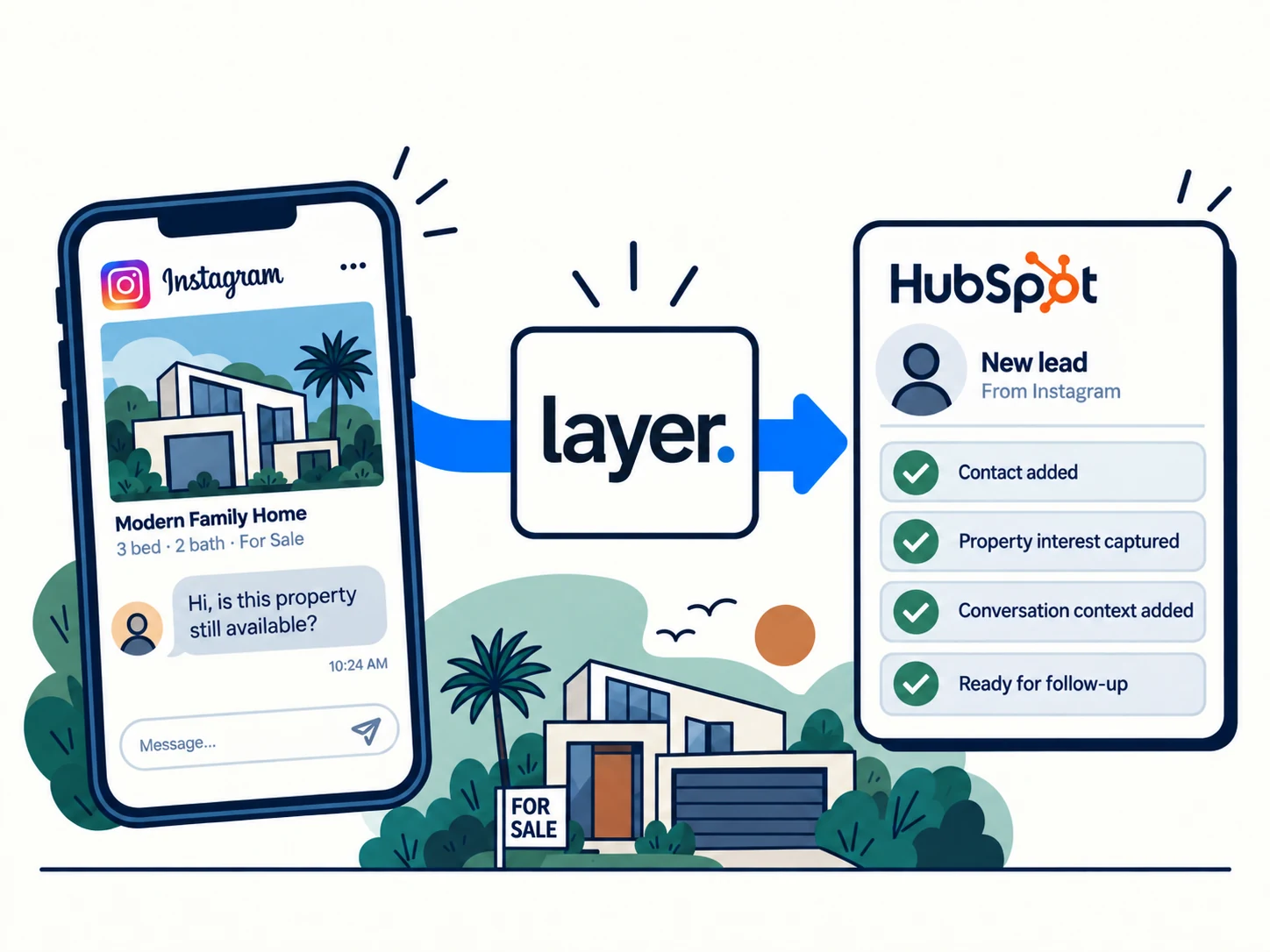
The leads were already coming in. The admin in between was the problem.
When somebody commented on a property post or sent a direct message, a member of the team had to pick up the enquiry and move it forward manually.
That meant deciding whether the message was a genuine property enquiry, replying, asking for the required information, waiting for the response, then transferring the completed lead and relevant context into the CRM before an advisor could take over.
Individually, none of those tasks took much time. Repeated across every property post and incoming enquiry, they created a constant layer of admin between customer interest and the sales team.
That was the part worth removing.
A focused workflow from Instagram to the CRM.
Layer now handles that process automatically.
A clear property enquiry enters the workflow. The prospect receives one approved request for the required details. The system waits for the response, determines when the intake is complete, prepares the lead and writes it into the CRM with the relevant customer and conversation context.
Then the workflow stops.
An advisor takes over from there.
The workflow is deliberately narrow. It removes the repetitive work before human judgement becomes useful.
How the workflow works
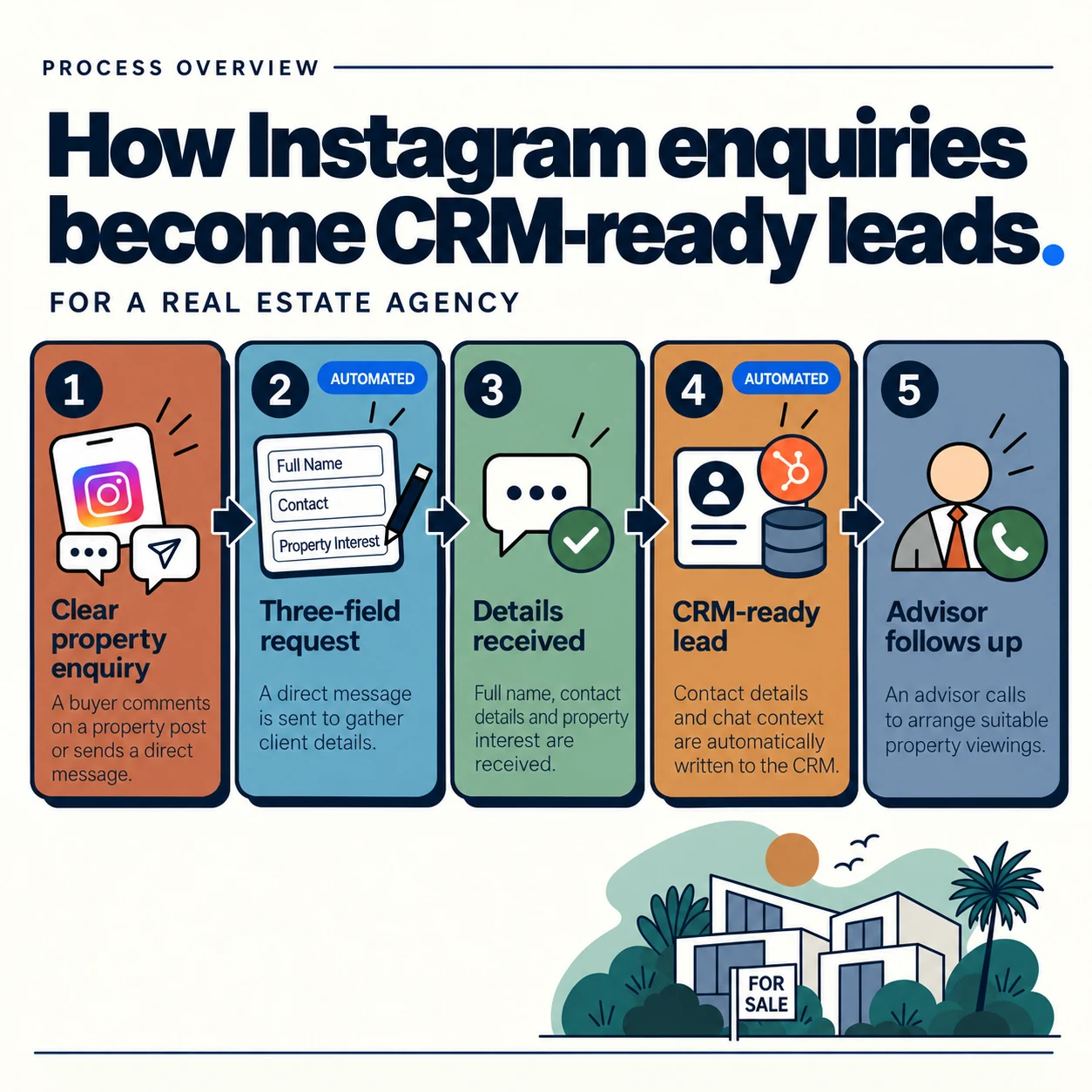
Automation handles the repetitive steps. The advisor handles the relationship.
01 · Clear property enquiry
A buyer comments on a property post or sends the agency a direct message.
The workflow distinguishes a genuine property enquiry from activity that does not need a sales response, such as a reaction or somebody simply tagging a friend.
For a clear comment enquiry, the prospect can receive a public acknowledgement before the conversation moves into the private intake. A direct-message enquiry stays private.
For the customer, it still feels like a normal Instagram conversation.
02 · Three-field request
For a clear enquiry, Layer sends one approved request for the three pieces of information needed to progress the lead.
The request is intentionally narrow.
The workflow does not improvise a sales conversation, invent property information or decide what the buyer should be offered. At this stage, it only needs to complete the intake.
03 · Details received
The workflow waits for the prospect to respond.
The information does not need to arrive in one perfectly formatted message. The conversation can develop naturally, and the workflow can determine when the required details are complete.
If the prospect has not provided everything yet, the enquiry remains incomplete.
It is not pushed into the CRM as a finished lead just to keep the automation moving.
04 · CRM-ready lead
Once the required information has been received, Layer prepares the lead for the CRM.
The contact is created or matched against an existing record, the opportunity is prepared, and the relevant customer and conversation context is carried across with it.
The advisor does not need to reconstruct the Instagram conversation manually before following up.
In HubSpot, they see a structured lead with the context needed to act on it.
05 · Advisor follows up
At this point, automation stops.
An advisor owns the next conversation, whether that means answering property questions, understanding what the buyer needs, arranging a viewing or deciding what should happen next.
Layer gets the work to the point where human judgement becomes valuable.
Not everything should be automated.
The workflow has a clear operating boundary.
It can recognise an agreed type of enquiry, request the required information, wait for the response, prepare the CRM record and move routine work forward.
Anything outside that boundary stays out of the automatic path.
An unclear enquiry can be left for review. An incomplete conversation stays incomplete. A failed delivery stays failed instead of being treated as successful.
Uncertainty and exceptions remain visible for review instead of being guessed through.
Building the workflow was only half the job.
Customer-facing automation still depends on external systems.
Connections expire. Providers reject requests. Webhooks can stop delivering events. Messages fail to send. CRM writes can fail.
So Layer also runs the operational system around the workflow.
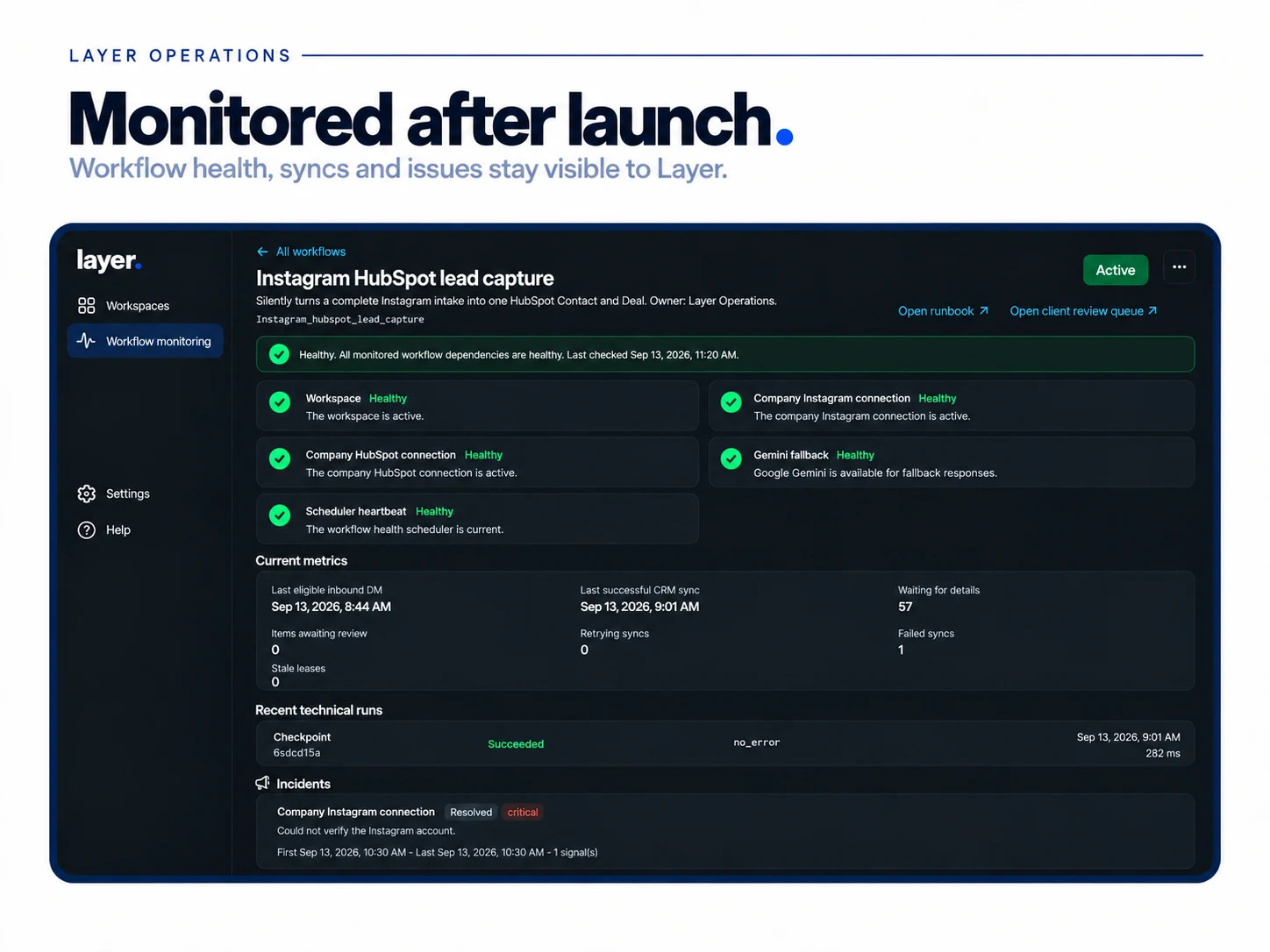
The monitoring layer tracks the workflow and the services it depends on, including Instagram and CRM connections, workflow health, AI fallback, scheduled health checks, CRM synchronisation and work waiting for attention.
It also records recent technical runs and incidents, so problems do not disappear behind a successful-looking interface.
A failed sync stays visible. A broken connection can be investigated. An issue that has been resolved remains part of the operational history.
And a quiet period with no new enquiries is treated differently from a workflow that has actually stopped working.
The aim is simple: when something goes wrong, Layer should know about it before the client has to.
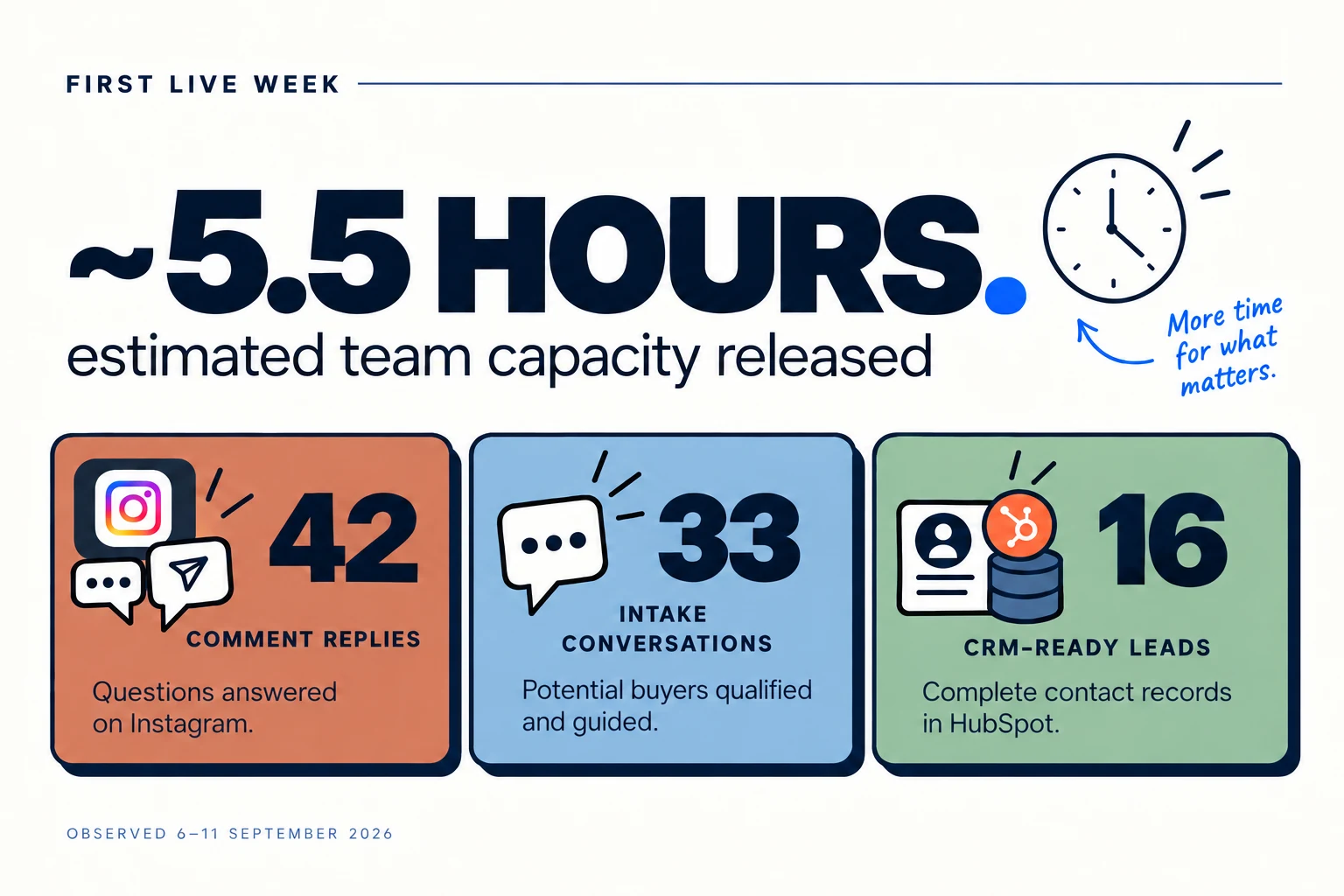
Around five and a half hours back in the first live week.
~5.5 hours
estimated team capacity released
Between 6 and 11 September 2026, the workflow handled:
42 comment replies · 33 intake conversations · 16 CRM-ready leads
Using conservative estimates for the manual work those actions previously required, that represented approximately five and a half hours of team capacity released during the period.
The estimate is based on:
- 42 comment replies × 2 minutes
- 33 intake conversations × 4 minutes
- 16 CRM-ready leads × 7 minutes
That comes to 328 minutes, or approximately 5 hours 28 minutes of repetitive work removed.
The figure is an estimate of team capacity released, not a claim about revenue or guaranteed weekly savings. Enquiry volume naturally changes with property posting activity.
Real usage exposed the edge cases.
Live traffic surfaced behaviours that were difficult to see in testing.
A prospect can enquire more than once. The workflow was strengthened so the same person cannot receive another intake while one is already being delivered or after it has successfully been sent.
Background work can also be interrupted. The CRM process was hardened so that if a job stops partway through and later resumes, completed work is not overwritten and the same lead is not accidentally created twice.
Monitoring needed adjustment too. A period without new Instagram messages should remain visible, but it should not be treated like a broken connection or failed delivery.
Each of those lessons became part of the production workflow.
What changed for the team.
The agency still owns the customer relationship.
Its advisors still answer property questions, understand what a buyer needs and decide what should happen next.
The repetitive work immediately before that is what changed.
Clear enquiries now move through a consistent intake. Required information is gathered. Complete leads reach the CRM with useful context. Duplicate work is prevented, and problems remain visible when something needs attention.
The advisor starts with a lead that is ready to work with instead of another piece of administration.
Layer removed the repetitive admin between enquiry and follow-up without removing the human judgement around it.