Most businesses already have more content than they realise.
The problem is often not a lack of things to talk about.
Useful material is being created constantly:
- Sales calls where customers ask good questions
- Meetings where the team solves real problems
- Customer interviews
- Project discussions
- Internal documents
- Product updates
- Lessons from delivery
- Recurring objections from prospects
- Observations from people inside the business
The difficulty is turning all of that into content consistently.
Someone has to remember the conversation, recognise that there was a useful idea in it, find the source material again, decide what could become a post or article, write the first version and move it through review.
That usually means good ideas disappear simply because nobody has time to capture them.
A Marketing Content Engine is designed to remove that coordination work.
How the system works
The basic pattern is simple:
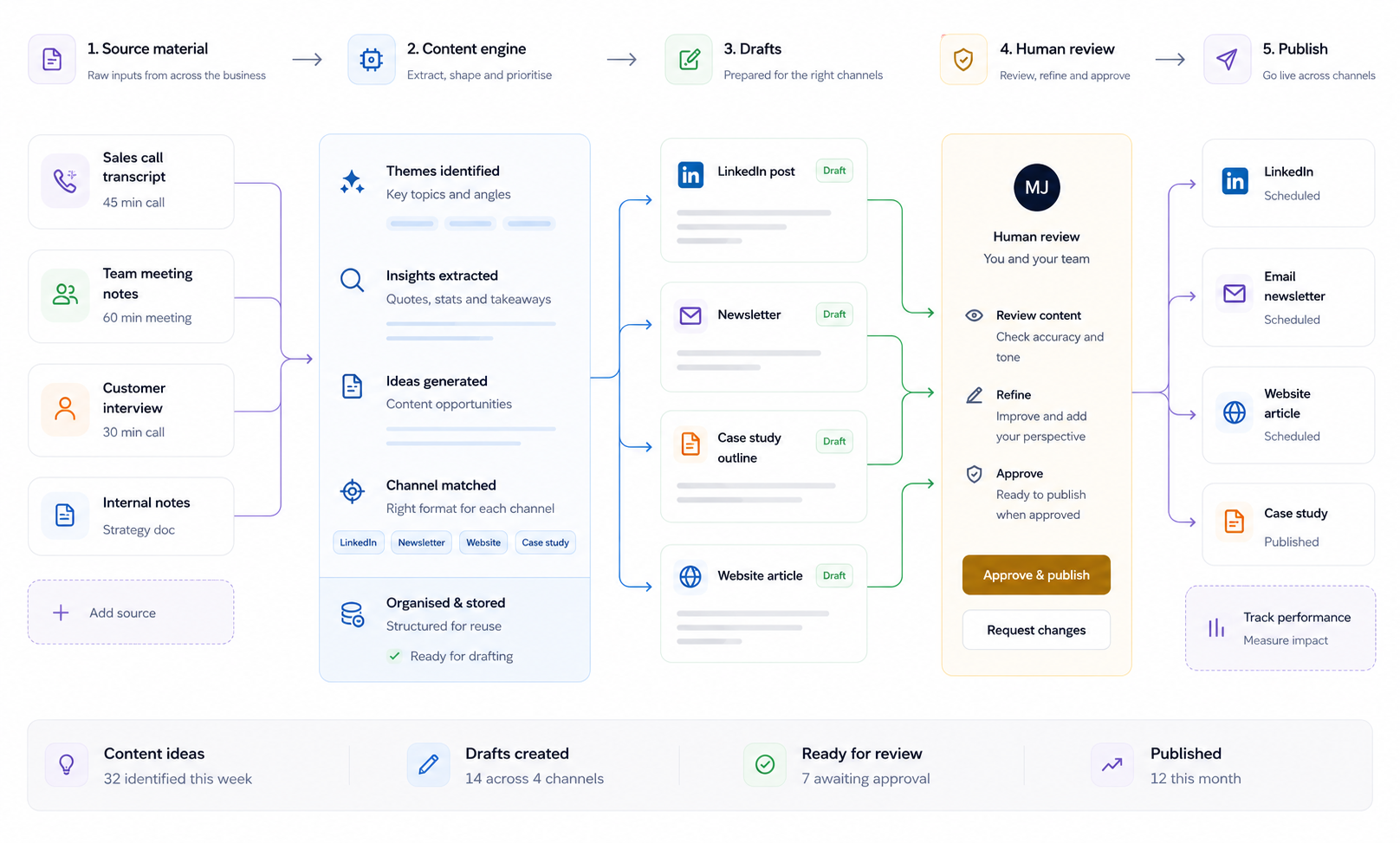
Calls, meetings and internal knowledge → useful ideas → first drafts → team review → publication
The system continuously collects approved source material from the places your team already works and turns it into structured content opportunities.
It does not need to replace your marketing team.
It gives them a better starting point.
1. Capture the material your business already creates
The system can be connected to appropriate sources such as:
- Meeting transcripts
- Sales-call transcripts
- Customer interviews
- Internal notes
- Approved documents
- Project updates
- CRM notes
- Existing marketing material
Instead of someone having to search through all of this manually, relevant material can be brought into one content process.
What the system can access depends on what the business chooses to connect and what information is appropriate to use.
2. Find the useful ideas inside it
Not every conversation deserves to become content.
The system can help identify the parts that might actually be useful:
- A customer asked the same question three prospects asked last month. That could become an educational post.
- A team member explained a problem particularly clearly during a meeting. That could become an article.
- A project produced a useful lesson. That could become a case study or founder post.
- A sales call surfaced a recurring objection. That could become content that answers the objection before the next sales conversation happens.
The aim is not to generate random topics.
It is to uncover the useful ideas already being created inside the business.
3. Shape the idea for the right channel
Once a worthwhile idea has been identified, the system can prepare it for the appropriate format.
One source conversation could produce:
- A LinkedIn post
- A short newsletter section
- A case-study outline
- A website article idea
- A sales enablement piece
The same idea does not simply get copied everywhere.
The content is shaped around the channel, audience and purpose.
Your existing brand guidance, previous approved content and internal context can also be used to help keep first drafts more consistent.
4. Prepare the first draft
This is where the system removes a large amount of blank-page work.
Instead of someone starting with “What should we post this week?”, they start with “Here are the strongest ideas from the work we’ve already been doing, together with first drafts and the source they came from.”
A draft can include:
- The original source
- The key idea
- Suggested angle
- Intended audience
- Proposed channel
- First version of the copy
Your team can then improve it rather than creating everything from scratch.
Your team still decides what represents the business
The system can capture, organise, suggest and draft.
It should not decide by itself what your company says publicly.
Before anything goes live, the appropriate person can:
- Review the source and draft
- Edit the wording or add their own perspective
- Reject weak or inappropriate ideas
- Approve content that is ready
Only approved material moves forward to publishing.
That distinction matters.
The aim is to automate the repetitive work around content creation, while keeping judgement, brand voice and final approval with the people responsible for the business.
It can work around the tools you already use
A Marketing Content Engine does not need to mean replacing your existing marketing stack.
Depending on the business, the system might connect with tools already being used for:
Meetings and calls. Teams, Zoom, Meet or existing transcription tools.
Internal knowledge. Google Drive, Microsoft 365, Notion or other approved knowledge sources.
CRM and customer context. HubSpot or the CRM already in place.
Content production. Existing documents, marketing tools or project-management software.
Publishing. The website CMS, email platform or social workflow the team already uses.
The exact technology comes after understanding how your team currently creates and approves content.
What this could look like in practice
Imagine your team has five customer and internal calls during the week.
Instead of those conversations disappearing into meeting recordings, the system reviews the approved transcripts and identifies six potentially useful ideas.
Three are weak and ignored.
Three are worth developing.
From those three ideas, the system prepares:
- Two LinkedIn drafts
- One newsletter section
- One website article outline
- One potential customer case-study angle
Each is connected back to its original source.
Your marketing lead opens the review queue, sees where each idea came from, makes the necessary changes and approves the content worth publishing.
The business has not created more meetings.
It has simply started getting more value from the knowledge those meetings were already producing.
What Layer would actually build
This is not an off-the-shelf product that every business receives in exactly the same form.
The example shown here represents the system pattern.
A real implementation would start by understanding:
- Where useful knowledge currently appears
- What sources are appropriate to use
- Which content channels matter
- Who needs to review what
- How brand guidance is maintained
- Which tools the marketing team already uses
- What should and should not be automated
Layer would then design the simplest system that connects those steps.
That might include deterministic automation for moving and organising information, with AI used where language understanding, idea extraction or drafting genuinely helps.
The practical outcome
The goal is not to produce more content for the sake of producing content.
It is to make better use of knowledge that would otherwise disappear.
A useful Marketing Content Engine should mean:
- Less time searching for ideas
- Less time starting drafts from scratch
- More content based on real company experience
- A clearer route from idea to publication
- Human approval before anything represents the business publicly
And most importantly: your existing work starts feeding your marketing instead of your marketing team having to constantly invent something new to say.
Example shown is a theoretical system design using synthetic data. Any real implementation would be scoped around the organisation's existing tools, information-access rules, content process and approval requirements.