AI is moving faster than most businesses can realistically keep up with. One week the advice is to automate everything. The next it is to give everyone an agent. Then agents are replacing workflows, workflows are replacing software, and before you have implemented the last thing, another tool has arrived.
The problem is not that all of this advice is wrong. It is that most of it starts with the technology.
There is a better place to start: How should the work actually flow through the business?
Before choosing a model, an agent, an automation platform or another AI tool, look at the work itself. What needs to happen every time? What needs to be understood? Where does somebody genuinely need to make a decision?
Once those questions are clear, the technology becomes much easier to choose.
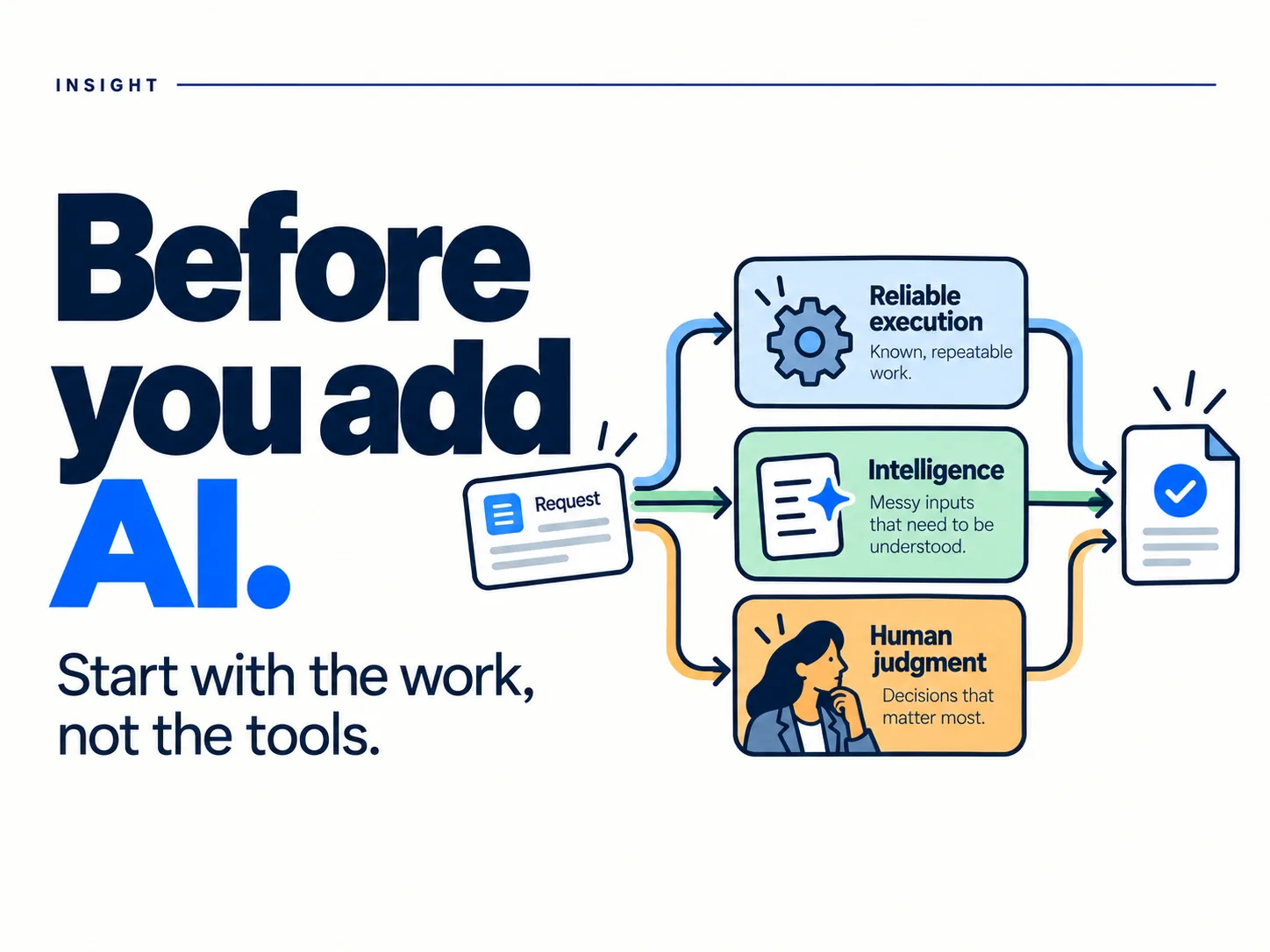
Start with the work
A lot of business work happens between the obvious systems and roles. A customer sends a request. Somebody works out what they mean. Information gets copied somewhere else. Another person decides what happens next. Someone updates a CRM. Someone else sends the response.
Over time, these processes accumulate. A spreadsheet here. A manual step there. Someone who knows who to chase. A workaround between two systems that do not quite talk to each other.
Most businesses did not deliberately design all of this. It simply grew with the company.
That is why “where can we add AI?” is usually the wrong first question. The better question is: What kind of work is happening here?
Most workflows contain a mix of three different kinds of work: Reliable execution. Intelligence. Human judgment. They need different kinds of support.
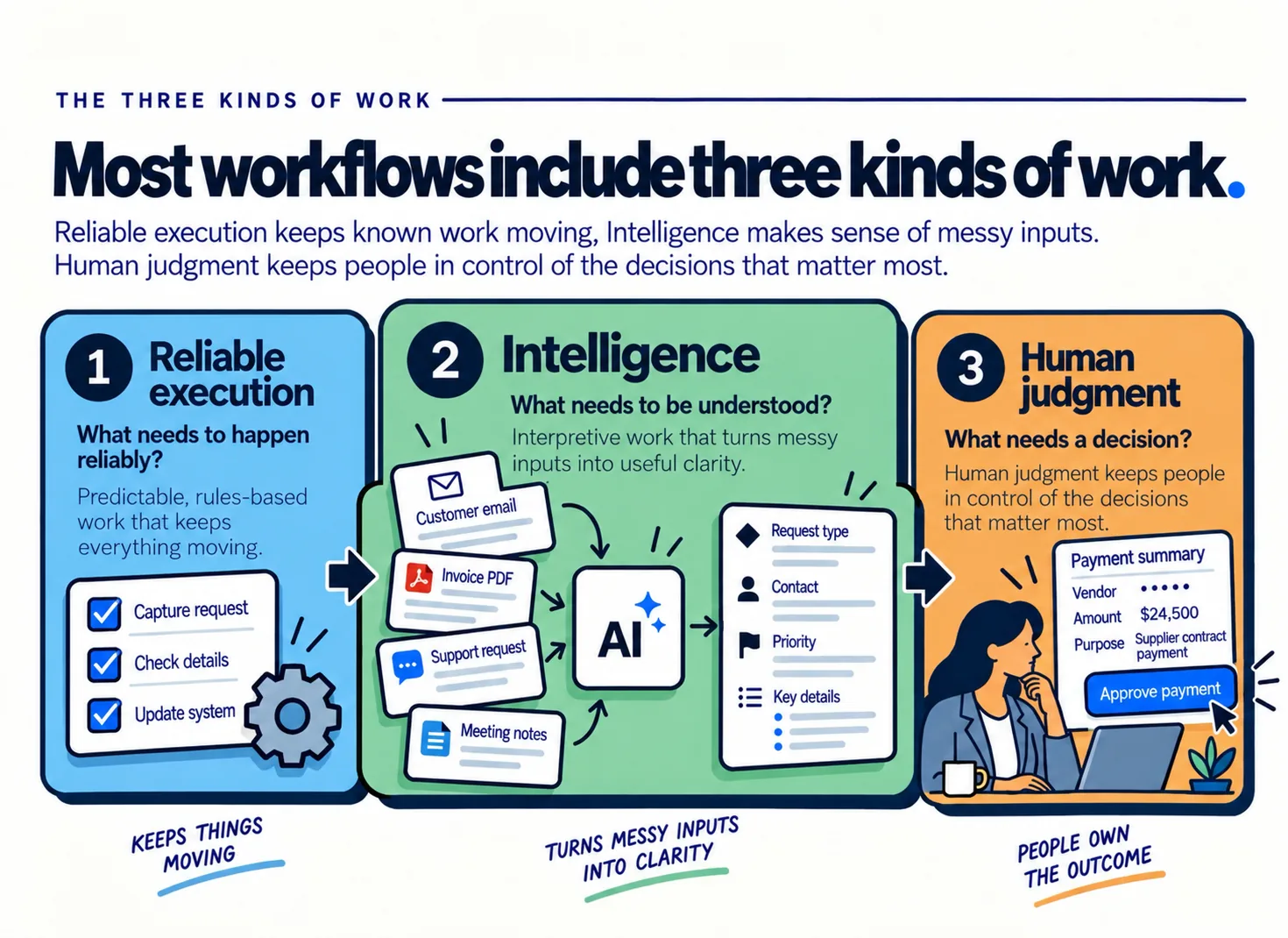
Reliable execution
What needs to happen reliably?
A surprising amount of business work is not a judgment call at all. You already know what should happen.
A customer books an inspection. A job needs to be created, the client record updated, the technician assigned and the right information sent. A qualified lead reaches a known stage. The CRM needs updating and the next task needs creating. An invoice is approved. The status needs recording and the document needs storing in the right place. A new employee joins. Onboarding tasks need creating and the right people need notifying.
None of those steps require creativity. They require reliability.
And as AI becomes more capable, reliable systems may become more important, not less. If you already know exactly what should happen, the system should usually just do it. That might mean an API, a workflow engine, n8n or something else. The tool is secondary. The important thing is that predictable work happens predictably.
If the answer is already known, do not add uncertainty just because AI is available.
Intelligence
What needs to be understood?
Real businesses are rarely as neat as their workflows. Customers write emails in their own words. Suppliers change document layouts. Technicians record notes differently. Support requests arrive with missing context.
This is where AI becomes genuinely useful. Reliable execution handles known actions. Intelligence handles messy reality.
AI can take an unstructured input and turn it into something the rest of the process can use. It can understand what a customer is asking for. It can pull useful fields from an invoice even when the layout changes. It can turn rough site notes into a structured draft. It can classify a request, extract the important details and identify what is missing.
A lot of the practical value of AI happens here. Not because AI is running the entire business process, but because it turns something messy into something usable.
There is an important limitation, though. Understanding is not the same as knowing. AI can be wrong. It can also be uncertain. Two situations can look almost identical and still require a different response.
That uncertainty needs to be part of the design. If confidence is low, the system should be able to stop. If something looks unusual, it should be surfaced. If a person needs to review it, the context should already be prepared for them.
AI can help the business understand what is happening. That does not automatically mean it should decide what happens next.
Human judgment
What still needs a person?
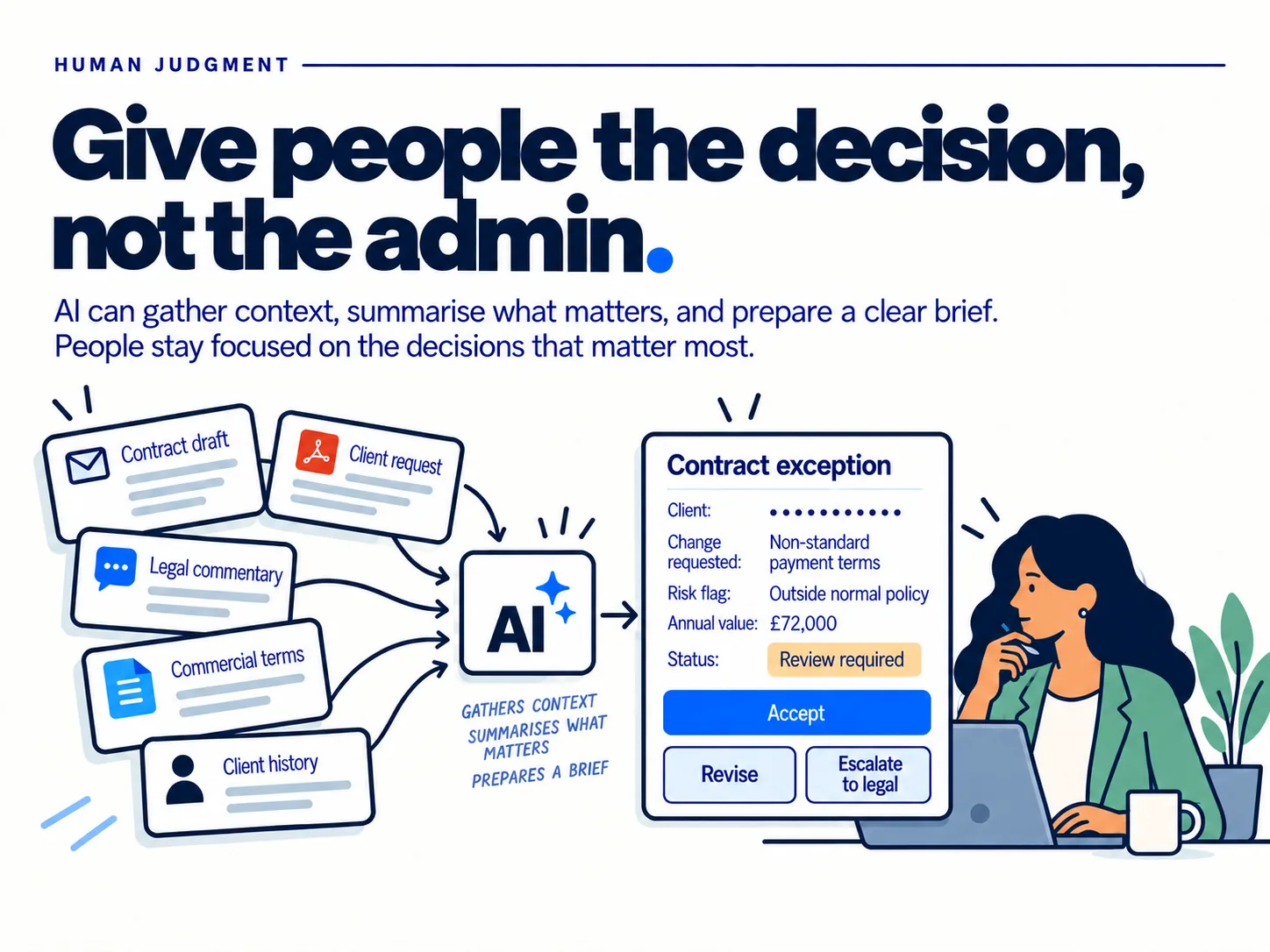
The goal is not to remove people from every process. It is to stop using them for work the system should already be handling and keep them focused on the moments where their judgment actually creates value.
In many businesses, people are still spending time copying information between systems, chasing updates, routing routine work and checking whether predictable steps happened. That work matters. But it does not necessarily require judgment.
Then there are the decisions where context, risk, accountability and consequences matter. A significant approval. An unusual contract term. A sensitive customer issue. A situation where there is no single obvious next step. Those are different.
Human judgment keeps people in control of the decisions that matter most. AI can still help. It can gather the relevant information, summarise what happened, surface unusual details and prepare a clear brief. But the person gets the decision, not the admin around it.
One workflow can contain all three
These are not three separate types of business. They can appear inside the same workflow, sometimes several times.
Take a customer booking an inspection. The request arrives as an email written in the customer’s own words. Some information may be missing. AI interprets the request, extracts the useful details and flags anything unclear. That is intelligence.
Once the request is understood, the next steps are known. Find the client record, create the job, assign the technician and send the confirmation. That is reliable execution.
After the inspection, the technician sends back rough notes. The format varies from person to person. AI turns those notes into structured findings and prepares a draft. Back to intelligence.
Then something unusual appears in the report. Now there is no obvious next step. A manager reviews the situation and decides what should happen. That is human judgment.
Once the decision is made, the uncertainty disappears again. The report can be sent, records updated and follow-up scheduled. Back to reliable execution.
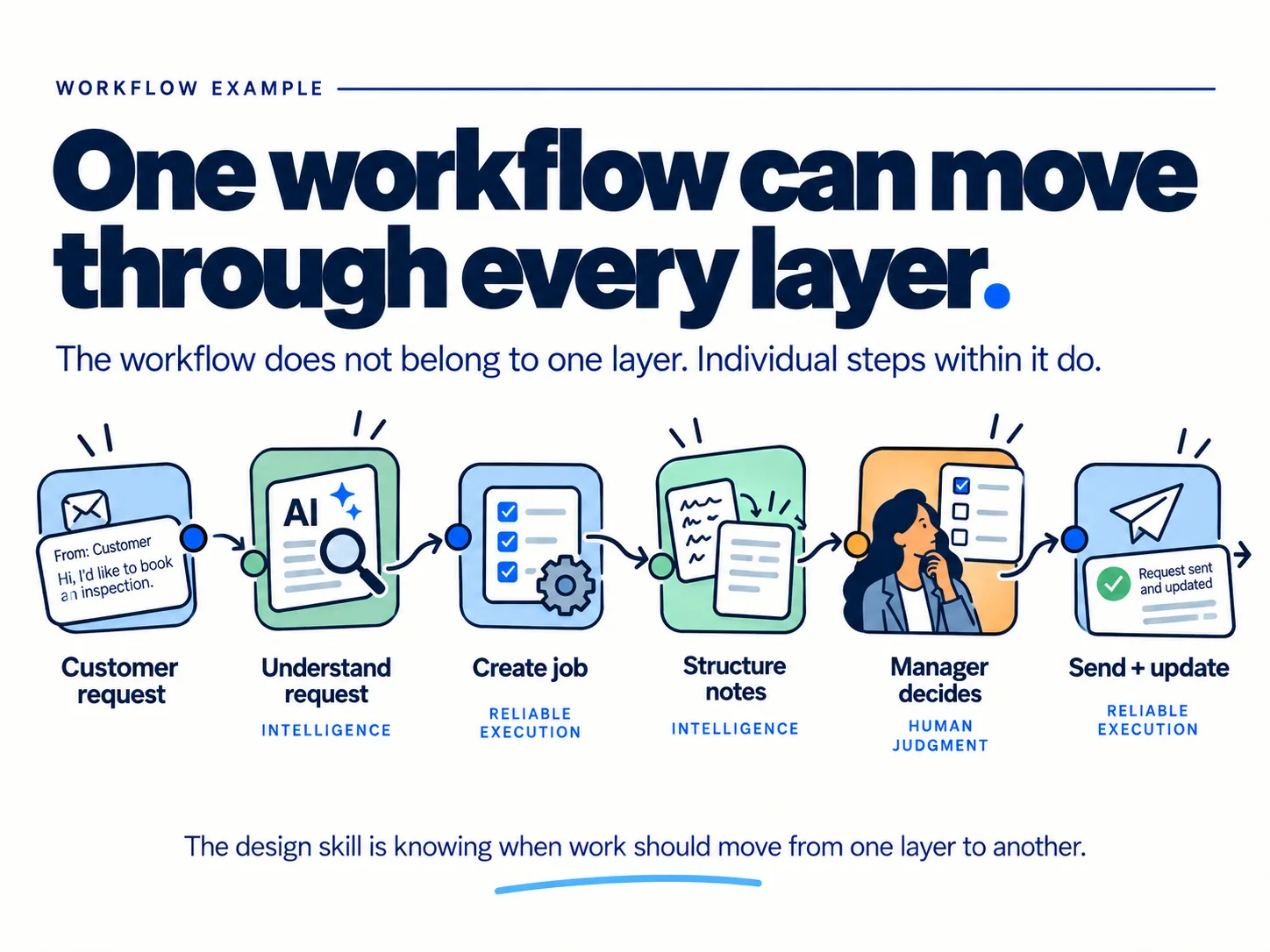
The important design question is not whether the workflow “uses AI”. It is knowing which part of the work needs which kind of system.
So where do agents fit?
Agents are useful, but they are not the answer to every workflow. A normal automation works well when the path is known. Something happens, the system follows a defined sequence, and the expected outcome is clear.
An agent becomes more useful when the goal is known but the route may need to change. It might need to inspect several systems, decide which tool to use, gather more information, ask for clarification or adapt after seeing the result of an earlier step.
In simple terms: A workflow follows a path. An agent can work toward a goal.
But that does not mean the agent should control everything around it. The surrounding workflow can still define the boundaries, permissions, stopping conditions and points where a person needs to step in.
If the next step should always be the same, there is usually little value in asking an agent to decide it again. If the next step genuinely depends on what the system discovers, that is where an agent starts to make more sense.
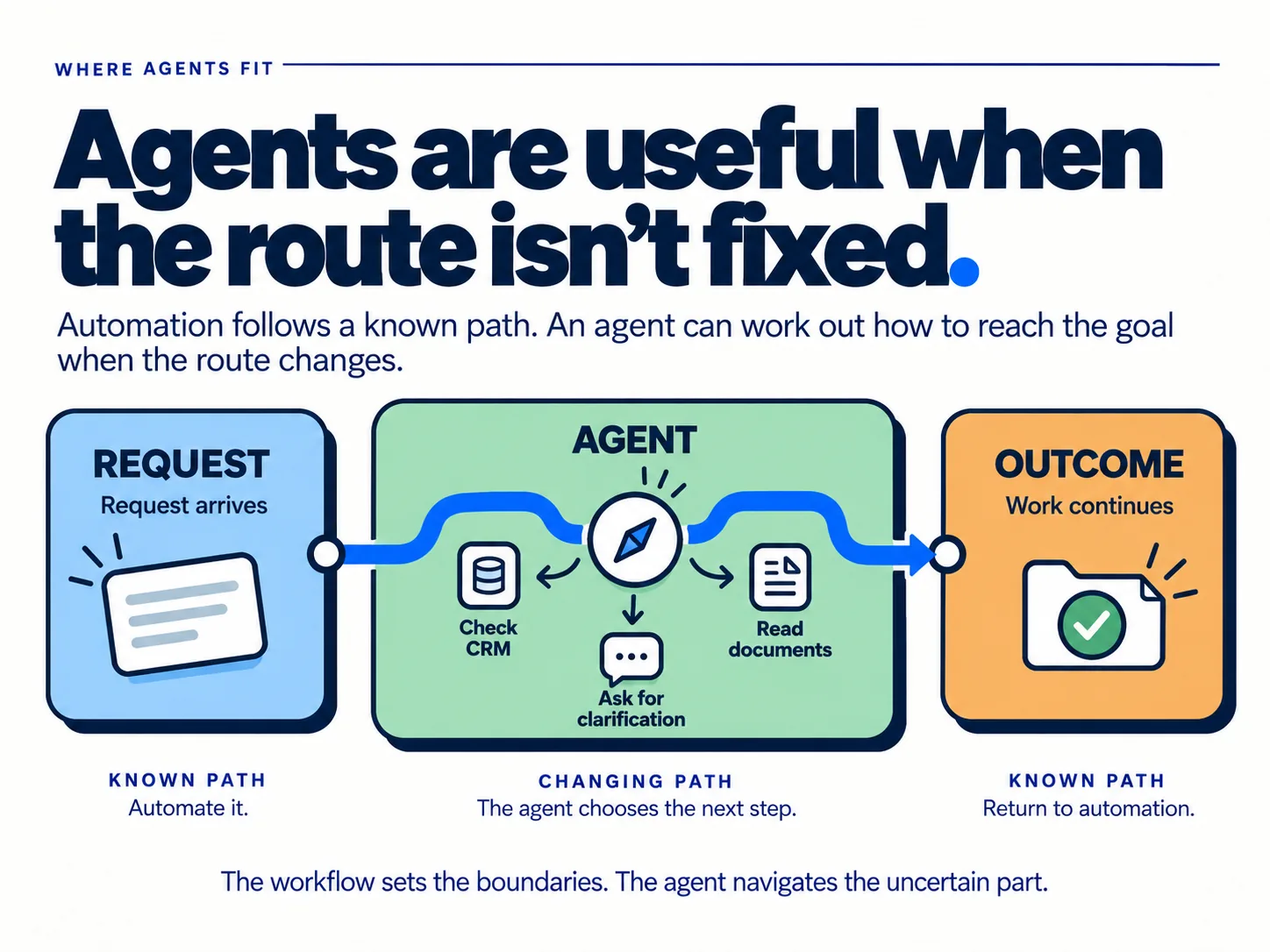
Agents do not remove the need for workflow design. They make it more important.
Technology should implement the design
Models will change. Agent frameworks will change. Workflow tools will change. The latest AI product will change. Your business process still needs to make sense underneath them.
That is why starting with a tool often leads to poor systems. The technology begins defining the process instead of supporting it.
A better sequence is: Understand how the work should flow. Separate what is predictable from what needs interpretation. Decide where human judgment still matters. Then choose the technology that supports each part.
The tool comes after the design.
More AI is not the goal
Using more AI is not what creates the advantage. The advantage comes from knowing where it genuinely helps.
What should happen automatically because the answer is already known? Where does AI help because the input is messy or the path can change? Where should somebody still make the call?
Get those decisions right and AI becomes much easier to think about. You stop trying to find places to insert the technology. You start designing better ways for the work to happen.
Start with the work.
Diagrams are illustrative. Example figures and names in the diagrams are not client results.